
Why Hay Matters: The Ultimate Foundation for a Healthy Rabbit
If you’re a new rabbit owner—or even if you’ve had buns for years—there is one rule that sits above all others: **Hay is life.** When people imagine a pet rabbit, they often think of carrots or those colorful bags of pellets from the pet store. But in reality, at least 80% to 90% of a rabbit’s daily intake needs to be high-quality grass hay. It isn't just "bedding" or a side dish; it’s the engine that keeps their entire body running.
The Big "Why": Why Hay Matters So Much?
Rabbits are built differently than us. Their entire physiology, from their teeth to their "second stomach," evolved to process tough, fibrous vegetation. In a domestic setting, hay is the only thing that mimics this natural diet.
1. Digestive Health and GI Stasis
Rabbits have a unique digestive process called hindgut fermentation. They need to keep food moving through their gut at all times. If the "conveyor belt" stops, they can enter a life-threatening state called GI Stasis (Gastrointestinal Stasis).
The long-strand fiber in hay provides the mechanical "push" needed to keep the intestines moving. It also feeds the good bacteria in the **cecum** (a large pouch in their gut), preventing painful bloating, gas, and harmful bacterial overgrowth.
2. Dental Health: The Never-Ending Growth
A rabbit’s teeth actually "never stop growing". Their incisors (front) and molars (back) grow continuously throughout their lives. If they don’t wear them down, the teeth develop sharp "spurs" that cut into their cheeks and tongue, making it impossible for them to eat.
Chewing hay—specifically that lateral, side-to-side grinding motion—is the only natural way to keep those teeth at a safe length. Pellets are too soft and dissolve too quickly to do the job.
3. Mental Enrichment & Foraging
Eating hay takes time. Because it’s low in calories but high in volume, bunnies spend hours foraging through their pile. This mimics their natural behavior in the wild and prevents boredom, which can otherwise lead to destructive chewing on your baseboards or carpet.
Navigating the Varieties: Which Hay is Best?
Not all hay is the same. Generally, you’ll be choosing between Grass Hays (for adults) and Legume Hay (for youngsters).
Grass Hays (The Daily Staple for Adults)
- Timothy Hay: The gold standard. It has the perfect balance of fiber, protein, and calcium for an adult rabbit.
- Orchard Grass: A great alternative for people with allergies. It’s usually softer and leafier, making it a favorite for picky eaters.
- Oat Hay: Crunchy and full of "seed heads." It’s great for variety but can be a bit higher in protein/fat if they only eat the seeds.
- Meadow Hay: A mix of different grasses and often some dried herbs. It provides great environmental enrichment because of the varied textures and smells.
Legume Hays (Proceed with Caution)
- Alfalfa Hay: This is actually a legume, not a grass. It is very high in calcium and protein.
- When to use it: Only for babies (under 7 months), pregnant/nursing moms, or severely underweight seniors.
- Why to avoid for adults: Too much calcium can lead to "bladder sludge" (calcium sand in the bladder) or painful kidney stones.
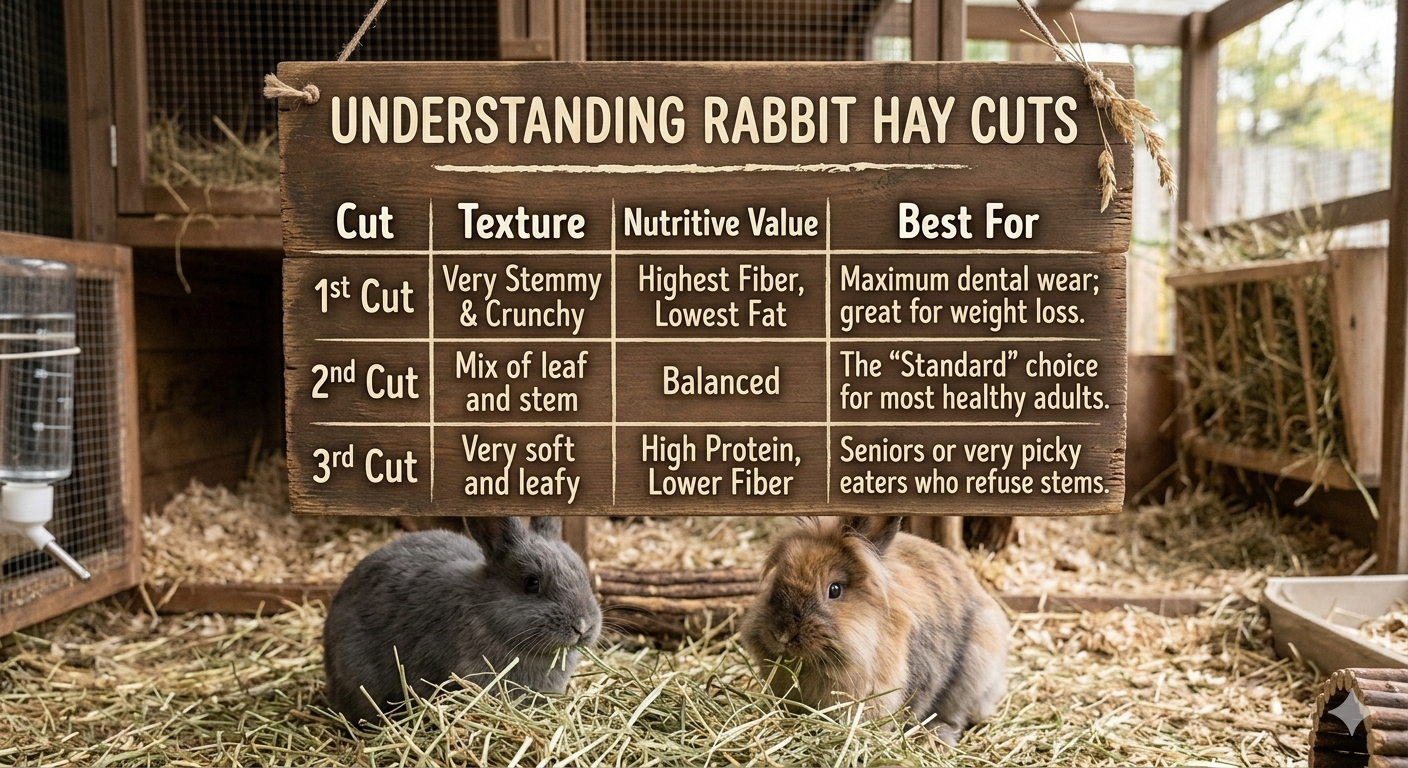
Understanding the "Cuts"
When you buy Timothy hay, you’ll often see "1st," "2nd," or "3rd" cut. Here’s what that means for your bunny
When you’re shopping for hay, use your senses. Good hay should be:
- Greenish in color: It shouldn't look like yellow, dried-out straw.
- Fragrant: It should smell like a fresh field, not dusty or musty.
- Dust-Free: Excessive dust can irritate a rabbit's sensitive respiratory system (and yours!).
The "No-Go" List:
1. Straw: People often confuse the two. Straw is the leftover stalk from grain harvests; it has almost zero nutritional value and is very hollow. Use straw for bedding, but never for food.
2. Moldy Hay: If the hay feels damp or smells "off," throw it out immediately. Mold toxins are deadly to rabbits.
3. Garden Grass Clippings: Never feed grass cut by a lawnmower. The heat from the blades causes the grass to ferment quickly, which can cause fatal bloat in rabbits.
What happens internally when a rabbit is deprived of hay?
1. Digestive Shutdown (GI Stasis)
A rabbit’s digestive system is essentially a one-way conveyor belt that must stay in motion 24/7. This movement is called motility.
- The Physical Trigger: Rabbits need "long-strand fiber"—the long, tough pieces of grass found in hay. When the rabbit swallows these, the fibers physically rub against the lining of the gut. This friction signals the intestinal muscles to contract and push food through.
- The Shutdown: If a rabbit stops eating hay and only eats soft food (like pellets or greens), there isn't enough physical "roughage" to trigger those muscles. The "conveyor belt" slows down or stops.
- The Result: This is a condition called Gastrointestinal (GI) Stasis. When food sits still in the gut, it begins to ferment and create gas. Because rabbits cannot burp or vomit, this gas expands, causing extreme pain. If not treated by a vet immediately, the rabbit can go into shock.
2. Dental Overgrowth and Painful "Spurs"
One of the most unique things about rabbits is that their teeth never stop growing. They grow several inches every year.
- The Grinding Action: To keep their teeth from growing through their jaws, rabbits must grind them down. Eating soft food doesn't help. Only the side-to-side, circular chewing motion required to break down tough hay acts like sandpaper to file the teeth down.
- The Formation of Spurs: If a rabbit doesn't eat enough hay, their molars (back teeth) grow unevenly and develop sharp, needle-like points called **spurs**.
- The Trauma: These spurs eventually grow long enough to pierce the rabbit's tongue or slice into their cheeks. This makes eating so painful that the rabbit stops eating altogether, which then triggers the digestive shutdown mentioned above.
3. Bacterial Imbalance
The rabbit's gut contains a "fermentation vat" called the CECUM. It is filled with specific bacteria that break down fiber into nutrients.
- pH Balance: For the "good" bacteria to survive, the environment inside the gut must stay at a specific acidity level.
- The Shift: Fiber from hay keeps this environment stable. Without it, the pH levels shift, causing the "good" bacteria to die off and "bad" bacteria (which produce toxins) to take over. This often results in "poopy butt" (uneaten cecotropes) or severe diarrhea, both of which are signs of a failing digestive system.
Pro-Tips for Feeding
- The Litter Box Connection: Most rabbits love to eat while they "go." Put a large handful of fresh hay directly into one side of their litter box. It encourages them to eat more and helps with litter training!
- Storage Matters: Keep your hay in a breathable bag (like canvas or the original perforated plastic) in a cool, dry place. Never store it in an airtight plastic tub, as it can trap moisture and grow mold.
Final Thoughts
Your rabbit’s diet is the foundation of their health. By choosing the right hay, you’re not just feeding them—you’re providing them with their most important medicine and their favorite hobby.
Always keep a stock of hay for your rabbits. For the freshest hay click here